The Lost Boys
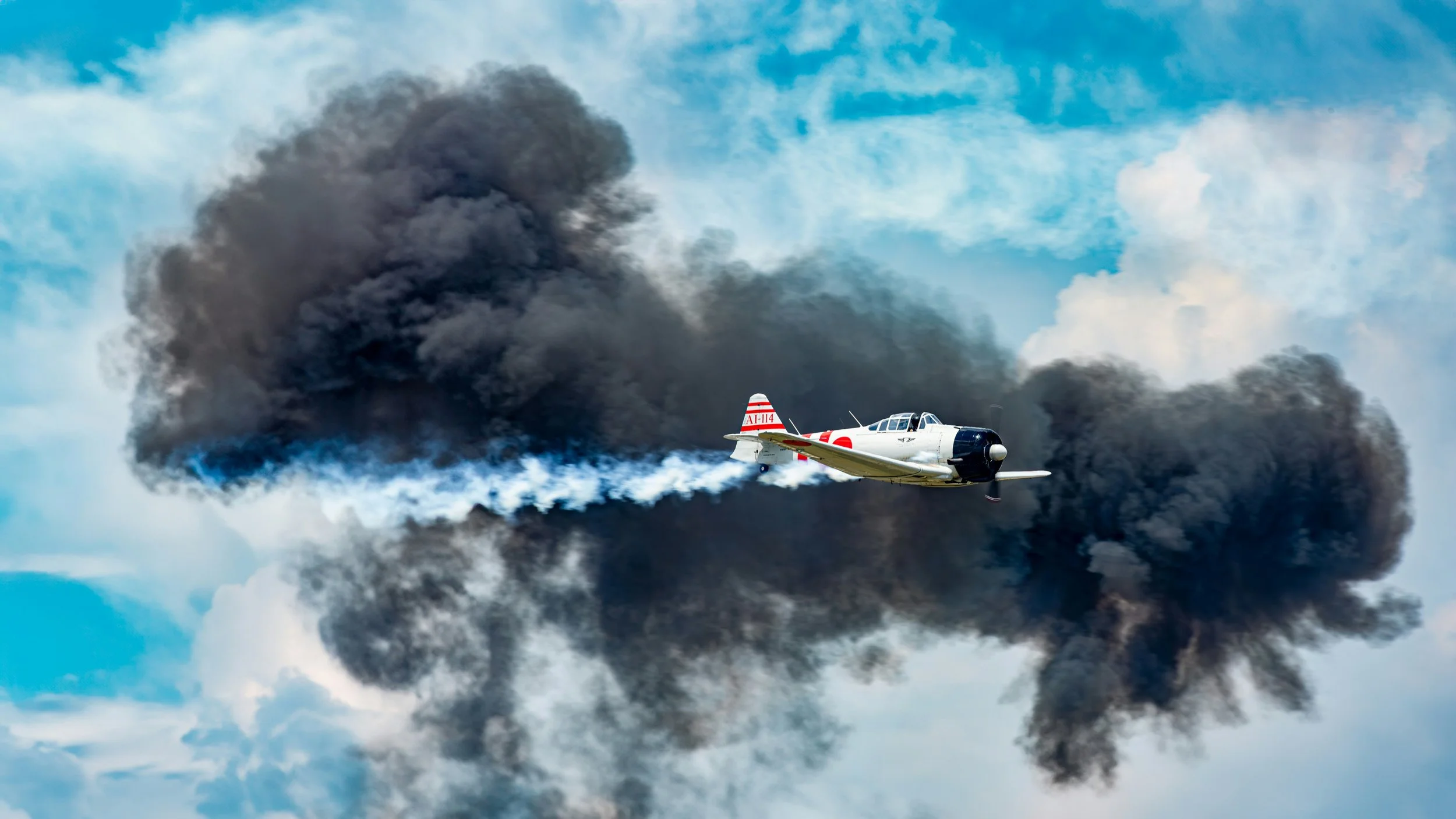
On December 8, 1941 four young men were on the beach at Howland Island, cleaning fish and setting them out to dry, when they heard an unfamiliar humming sound in the distance.
Howland is a tiny atoll in the equatorial Pacific, about half the size of New York’s Central Park. Situated some 1,700 miles from Honolulu to the northeast, and roughly the same distance from Australia to the southwest, it's just about as far away from civilization as you can get. The electric blue waters of the surrounding lagoon, coupled with the cobalt of the open ocean beyond, give islands like Howland an almost ethereal beauty, at least in photographs. In real life Howland is unwelcoming in the extreme, characterized by scratchy low vegetation, rocks and rock-like dead coral, and punishing sun.
One of the four men on the beach that day, 26-year-old Joe Keliʻihahanui, spotted a group of planes flying in formation—nine twin-engined bombers coming in high from the northwest. A moment later, thousands of nesting birds across the island took off into the sky.
News about the previous day’s attack on Pearl Harbor had not yet reached the tiny island outpost, but Keliʻihahanui and the others understood at once: America was at war. They began scrambling for the high spot in the center of the island, where the brush offered a modicum of cover. Suddenly bombs began exploding all around them. Keliʻihahanui and Richard “Dickey” Whaley ran one way, while Elvin Kanaina Mattson and T. W. Bederman went another.
Some twenty bombs fell before the Japanese warplanes swung around for a second pass. The blasts shook the island like an earthquake. Smoke and dust from pulverized rock filled the air. A few of the planes came in low and began to strafe the camp’s airfield and lighthouse with machine-gun fire. The four men living on the island did not have even one revolver with which to defend themselves.
Through the noise, Mattson thought he heard screams, but he wasn’t sure. Even if he had, there was nothing he could do. The men were pinned and alone on the edge of the world.
How those young men ranging in age from 17 to 27 came to be stationed on Howland and neighboring islands is an overlooked story of exploitation that traces back to the early 1930s. With the dawn of transoceanic air travel, transportation officials in Washington began thinking seriously about routes to Australia. Aircraft of the period could not make the journey without stopovers for refueling, so the idea of establishing landing points along the way gained traction within the Department of Commerce. Amidst the vastness of the Pacific, only certain locations were large and flat enough to host a runway and related infrastructure.
At the same time, the broader strategic picture in the Pacific was shifting rapidly. Japanese expansion had already altered the balance of power in the Far East, giving remote islands outsized strategic significance, a fact that would soon become all too evident: think Midway, Tarawa, Iwo Jima.
But claiming distant desert islands in a manner acceptable to the international community required a functioning presence; merely planting a flag wouldn’t cut it. As the history of Pacific voyagers dating back millennia has demonstrated, the key to colonizing was inhabitation. People had to live there. In 1935, a top-secret program was launched, and in May of 1936, President Roosevelt codified it with Executive Order 7368. The initiative, dubbed the American Equatorial Islands Colonization Project, placed the islands of Baker, Howland, and Jarvis under the jurisdiction of the Department of the Interior. Two years later, another order did the same for the islands of Canton and Enderbury.
It was the U.S. Bureau of Air Commerce’s responsibility to find settlers. With zero sense of irony and a hefty dose of racism, officials decided to recruit their colonists in the recently colonized Territory of Hawai‘i. They turned to the Kamehameha School for Boys, one of Hawai‘i's premier private schools, to identify students and recent graduates who met a practical set of requirements. As Bureau documents described, “[t]he boys have to be grown-up, know how to fish in the native manner, swim excellently and handle a boat, that they be disciplined, friendly, and unattached, that they could stand the rigors of a South Seas existence.” Both the bureaucrats in Washington and leadership within the U.S Navy and Coast Guard knew, or at least had an implicit understanding of, the risks involved with this operation. Certainly more so than a bunch of 18- to 26-year-olds.
Compensation for participation in the expeditions was three dollars a day—decent pay in post-Depression era Hawai‘i. But beyond money, the program offered something irresistible: true adventure. The fact that basic details of the mission remained top-secret only added to the boys’ sense of excitement.
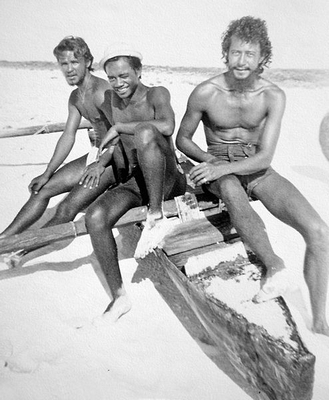
On March 20, 1935, the first South Seas Survey Expedition team was on its way, sailing from Honolulu for the nearly 1,700-mile voyage. Not that their special operation granted the colonists special status aboard the ship. As far as the all-white crew of the Coast Guard cutter Itasca was concerned, the Hawaiian boys were second-class citizens. From the start of the voyage they were given chores reserved for the lowliest grunts—scrubbing, cleaning, washing. Still, their spirits remained high. In one surviving photograph, a group of ten men pose with huge smiles, one of them holding a ‘ukulele.
When they first spotted land, the young settlers were not thrilled. “[I]t was sickening,” recalled colonist George Nuuanu West, writing about his arrival at Jarvis Island. “All I could see was a bumpy piece of white sand, glaring in the sun, and scarcely above the ocean.” The assignment that had sounded like adventure was suddenly looking more like exile. As one federal official put it, this place was “hell on Earth...the islands are lonely as prisons, in most of the places no shade exists and that an almost unbearably hot sun bears down on them all day, every day parching the skin and hurting the eyes regardless of protective glasses… I do say that mainlanders cannot stand these assignments.”
Despite such brutal conditions, the teams set about constructing rudimentary camps, and eventually cabins. Outposts took shape in stages as materials were hauled ashore along with foodstuffs and 55-gallon drums of drinking water. Part of the mission included an attempt to farm coconut trees, radishes, and other hearty crops in the nutrient-starved soil. On Howland, the men soon began clearing land for a barebones airstrip, and built stone walls to protect their outdoor “kitchen.” They also erected a flagpole for flying the Stars and Stripes, and hung a sign that read, "Kuu Home," which translates loosely from Hawaiian to mean Home Sweet Home.
Among the earliest recruits was a strapping Hawaiian named James Christian Kamakaiwi, a 24-year-old Kamehameha graduate. After tours lasting around three months, most of the colonists were eager to return to family, friends, and the comforts of life back on O‘ahu. “The only sickness that ever visits our camp is homesickness,” wrote one participant.
But Kamakaiwi was different. He chose to stay at Howland for many tours in a row. Life there suited him. “After an early breakfast,” he noted in a letter dated December 9, 1935, he walked to “the south point [of the island] at low tide to collect marine specimens for the Bishop Museum. Crabs, eels, shrimps, star fishes, sea cucumbers and other specimens were found.” His chronicles, composed mainly of everyday routines and excursions, convey an unmistakable sense of contentment. August 1, 1936: “While sitting in the shade under the entrance roof,” he wrote in the team’s logbook, “I watched four dainty and spotless white love terns glide gracefully to and fro in the wind.”
Kamakaiwi rarely complained about the heat, or anything, really. About a worsening toothache, he skipped the frustration and stuck with the practical: “I hope it will stop soon otherwise I will have to do the best I can to yank it out.” Not even the island’s resident rat population got under his skin. Most nights, Kamakaiwi reported, “several hundreds of these pests” could be seen scavenging about. While one of the other colonists waged an ongoing and mostly futile battle with the rats, Kamakaiwi preferred making observations of the “beautiful third quarter moon [that] is overhead tonight,” or the frigate birds “gliding lazily.”
Although the landscape around the colonists felt almost lifeless, underwater was a different story altogether. The coral reefs surrounding the islands are some of the most pristine in the world, as vibrant and busy with life as the adjacent land is bleached and arid. Whenever ocean conditions permitted, the men dove along the edge of the reef, spearing fish to fry up for dinner. Here, as one colonist put it, was “nature in the raw.”
But a healthy reef also meant sharks. One of the boys from Hawai‘i reported that the sharks at the remote islands were “vicious when hungry, and furious when blood-teased.” Yet the colonists’ lives were so intertwined with the reef that they had to figure out how to coexist with the sharks. Usually, explained West, the humans had an “advantage” in the shallow lagoon, as the shark’s fin was often visible above the water. Still there were close calls. West again:
One morning I was wading through the reef holding a bleeding fish which I had just speared by the tail. Suddenly I felt a heavy jerk. Turning around I saw a good size shark splashing away. I soon discovered that in my hand was only the tail of what had been fish. It had bit the fish right clean up to my fist.
Another time, when a US Coast Guard vessel stopped at Jarvis, the ship’s physician was trying to fish from the reef when he was suddenly swept away by an unexpected wave. “His cries were weak but fortunately they were heard,” remembered West. One of the colonists jumped into the water and swam the man back toward shore. “In a very short time that very scene became a mecca of sharks. The doctor, pale and frigid, lay unconscious for several minutes.”
When the day’s work of farming, construction, weather observations and specimen collection was done, the boys had free time to spare. They boxed, lifted dumbbells, listened to music on the radio, played baseball, and even wrote poetry about the technicolor sunsets “no mortal eye can resist.” On Jarvis they dove and explored the wreck of a ship called the Amaranth, which went aground in 1913, pulled planks from its hull, and fashioned serviceable surfboards. One colonist, still in high school, had next season’s football tryouts in mind: before sailing for Jarvis, he borrowed a pair of spikes and a football to bring with him to the island. Running and training in the sand, he hoped to be in top form when he returned to O‘ahu.
The islanders also explored scattered ruins from earlier visitors. For a brief stint in the mid-nineteenth century, Howland, Baker, Jarvis and other faraway Pacific atolls were of great interest to American entrepreneurs in the fertilizer trade. The crowds of seabirds that nest on the islands provide a steady supply of droppings, which are rich in nitrogen, phosphorus, and potassium. The 1856 Guano Islands Act stated that the U.S could claim as its own any uninhabited islands full of guano, provided the mined material was sold to American farmers. Ship owners began traveling to the islands and establishing camps for this new venture. But with the discovery of mineral deposits closer to home and the near depletion of guano on the atolls, the Pacific guano boom quickly went bust.
When storms weren’t pummeling the islands and the sun was not at its zenith, the colonists could relax and appreciate the novelty of their mission. “We of Jarvis have had our tense moments—but life was not always so,” wrote West.“We have been happy as well as troubled. The nights on Jarvis are beautiful and cool. We used to sit out in the moonlight and sing until late. Most of the time we sat up and played cards until midnight… That was our nightlife.”
Kamakaiwi spent almost all of 1935 on the island and became Howland’s de facto leader. He was back again in 1936 and 1937. His surviving correspondences are a blend of housekeeping and messages to people back home in Honolulu, and convey no concern that he and the other boys might be in harm’s way. Writing to the principal at Kamehameha, Homer F. Barnes, Kamakaiwi asked Barnes to deposit his paycheck into a savings account for him. “Please thank Mr. Hudson for his kindness in sending us newspaper articles and the Ka Mō‘ī,” he added, referring to the school student newspaper. Upon closing, he wrote: “We are in good health and hope the same of you and the Kamehameha faculty and students.”
Many of the boys were close with Barnes, who was both proud of his former pupils and concerned for their wellbeing. Yet the relationship was complicated considering the power, race, and colonial dynamics of the day. On the one hand, the school’s link to Roosevelt’s colonization project was a source of pride. On the other hand, Barnes must have understood the dangers of the program. Would he and officials in Washington have been equally eager to send boys to the remote Pacific if they had been not from Kamehameha Schools, but from an elite private school in Connecticut? (Barnes was also responsible for halting instruction of the Hawaiian language at Kamehameha, claiming that doing so would be beneficial for boosting student achievement. His wife, in contrast, was a longtime champion of hula dancing tradition.)
What is clear is how competent and capable the young men from Hawai‘i proved to be. “The duties performed by these men are severe,” wrote a U.S Army Captain who visited the islands. “Isolated on a desert island… of only a few acres is per se, a strain. Under such conditions, to be faithful in recording weather observations, keeping detailed daily logs, collecting scientific specimens, cleaning landing fields, establishing effective camps, preserving food supplies and keeping up morale are real accomplishments… I have been intimately associated with eleven classes at the US Military Academy and feel that [these young men] measure up to the standard of selection insisted upon there…”
During the summer of 1937, Kamakaiwi and the other residents of Howland were busy preparing for the arrival of two very special guests: aviatrix Amelia Earhart, arguably the most famous person on Earth at that time, and her navigator Fred Noonan. The island was to be one of Earhart’s last stops before completing her circumnavigation of the globe. In anticipation of her landing, the boys put up curtains in the cabin, and even fashioned a shower with a water drum and an oversized tomato can with holes punched through the bottom.
July 2 was going to be one of the proudest days of the entire mission. Describing those events, Kamakaiwi reported that he and the other men had awakened before daybreak. They listened to radio updates of Earhart’s Lockheed 10-E Electra “nearing Howland rapidly.” Kamakaiwi was “particularly eager,” he noted, as he had “the honor of welcoming Miss Earhart as chief resident of the island.”
By 7:30am personnel from the Itasca had arrived on shore to provide additional support. “[E]veryone seemed tense and sort of breathless [as] we watched the sky hoping to pick the plane out against white cumulus clouds which were all around the horizon,” Kamakaiwi wrote. They waited in silence, watching giant frigates soar high in the air, looking at times like airplanes.
“[H]opes were raised several times but no Amelia,” Kamakaiwi continued. When the men learned that Earhart was “believed down,” the shore party from Itasca quickly made for the small boats and rowed out to the ship, which would soon commence an exhaustive search of the area. In his update to the Itasca, Kamakaiwi wrote, in the staccato format of a radio transmission:“[M]y heart stopped beating it didn’t seem real… eight of us colonists were left behind we were alone again on the island the noise of the birds seemed louder we waited… I couldn’t make myself believe Amelia had missed us we kept watching the sky at eleven thirty seven HST the Itasca started out to sea towards the northwest soon she was disappearing over the horizon were waiting I hope with all my heart they find her.”
The tragedy of Earhart’s disappearance also illuminated a damning inconsistency. For Earhart, ships and other resources were activated for a search and possible rescue. But there would be no such response a few months later, when one of the colonists, Carl Kahalewai, suddenly fell ill with what turned out to be appendicitis. It didn’t take long for his peers to conclude that Carl needed fast medical attention. A ship with a doctor aboard set sail from Honolulu, but it was five days to Jarvis and five days back, and Kahalewai died en route to Hawai‘i.
Kahalewai was later described as a bright, cheerful and ambitious young man. “Sadness and bereavement filled the Hawaiian air,” went one account, “as the Coast Guard Cutter Taney arrived at Honolulu at half-past eight o’clock on the morning of October tenth. Carl Kahalewai came home aboard the cutter from Jarvis Island but his soul had joined his ancestors.”
If the dangers of their remote assignment had previously eluded the young adventurers working for Uncle Sam, Kahalewai’s death made the situation all too clear. By 1940 the prospect of war only added a new level of threat, so much so that officials in Hawai‘i suggested ending the colonization program. The completed runways and radio towers were likely targets, putting the boys directly in harm’s way. Military brass disagreed, arguing that it was precisely the wrong time to reduce U.S. presence anywhere in the Pacific. But no one thought to inform the boys of the increasing risk, or to ask if they wished to continue their faraway assignment.
When the Japanese bombers finally pulled away, Mattson and Bederman ran to where their friends had taken cover. Both Keliʻihahanui and Whaley were bleeding badly from severe shrapnel wounds to the legs and torso. The two survivors moved quickly, trying to fix up a way to move their friends. Whaley was alert enough that he asked to be moved to a high point on the island where he could see the ocean. The two uninjured men were able to move him, but both he and Keliʻihahanui died within minutes.
That night, Mattson and Bederman, barely able to process what had happened, tried to find a place to sleep. They didn’t trust the island’s barebones shelter enough to stay inside, so they gathered bedding and slept on the beach. Two days later, before dawn, they saw “a dark gray shadow, looking big and sinister, just outside the reef.” A submarine, sitting low in the water. At first light, the shelling began. Rounds slammed into the buildings, knocking out what remained of the radio equipment. The island was now completely cut off.
The two men hurried to bury their friends in a bomb crater, then constructed a makeshift hideout. They dug a trench about two and a half feet deep, covering it with grass as best they could. It was pathetic as foxholes go, but it was something. They stayed there for days: playing checkers, reading, and sleeping when they could. Other nights they scavenged for cans of food that had withstood the attack, and cooked on the one stove from camp that still worked.
On neighboring Baker Island, less than 40 miles away, the situation was similar. The Japanese bombers had hit the colonists’ shelters, and with them much of the food and water supply. Still, the survivors managed to salvage tin from the roof of the cabin and used it to help cover their foxholes.
In the aftermath of the attack, and with the realization that America was now at war, the boys of the South Seas Survey Expedition figured that even if they survived further attacks, they would still likely die from thirst. They could always eat because they could always catch fish. But without a resupply of drinking water, it was doubtful they would make it more than a few weeks. As for a rescue, they assumed that, with the U.S. embroiled in a global conflict, there was no way the Coast Guard or the Navy would send a ship on a two-week, 1,700-mile mission just to save a handful of self-described “local boys” from O‘ahu.
But they underestimated themselves. Within days they had juryrigged systems for collecting rainwater. They also carefully rationed perishable foodstuffs that had not been destroyed, while fishing the reef at night for further sustenance. They developed a taste for young terns, which they could catch simply by walking up and grabbing them. Perhaps most impressive of all, they kept their wits about them.
The weeks continued to tick by, with the boys spending hours and hours in their makeshift foxholes. Small celebrations gave the two surviving colonists on Howland a sense of connection to the world beyond. On Christmas and New Year’s Day, they ate two of their remaining chickens, “to help celebrate the holidays and to remind us of what we were missing at home,” recalled Bederman.
Still, by early January, things looked bleak. As Bederman later told LIFE magazine, they knew they were “in the middle of this war's no man's land” and wondered if they would have to remain there for the duration of the war.
But then on January 31, nearly two months after the attacks, a ship appeared at dawn and anchored outside the reef. Weeks of hiding had conditioned Mattson and Bederman to treat anything approaching the island as a threat, so they stayed where they were, watching from cover. A landing party came ashore and began walking up from the beach. Only when the figures drew close enough for the colonists to see individual uniforms and a blond-haired sailor did the two boys finally feel safe enough to crawl out of their hiding spot and identify themselves.
Aboard the destroyer USS Helm the colonists were in a state of visible shock. One of the sailors in the landing party later recalled how he and his crewmates had “found those guys living like Robinson Crusoe.” They left Howland and sailed on to gather the remaining survivors on Baker and Jarvis. Mattson and Bederman informed the others of the death of their two friends, but other details of the somber reunion aboard the Helm are lost to history.
When they reached O‘ahu, there was no fanfare. It was wartime, after all. Family members, many of whom had concluded that their loved ones were dead, were stunned, then overjoyed. As for their mission in the equatorial Pacific, the boys were told never to speak of their ordeal. They were expected to move on, find work, and resume their lives.
In the years and decades following the war, the boys of the American Equatorial Islands Colonization Project went on to become police officers, mayors, and professors. They called themselves the Hui Panalā‘au, which is Hawaiian for “society of colonists.” George Nuuanu West was a longtime journalist with the Honolulu Star-Bulliten. Edwin H. Bryan Jr. became a naturalist specializing in Polynesia. James Christian Kamakaiwi went on to work at the Pearl Harbor Navy Yard, before taking a job with the telephone company. He died in 1967 at the age of 53.
By the imperial metric of territory gained, the project was successful, paving the way for claims that would have major implications for the war and for the present. Today those remote atolls and surrounding waters are U.S jurisdictions, part of the United States Minor Outlying Islands. They are also part of a National Marine Sanctuary covering an area of ocean roughly one-third the size of the continental U.S. What those outlines on the map fail to convey, however, is the story of those remote encampments, the boys who lived there, and the adventure that became a tragedy.
Author’s Note: The Bishop Museum, Hawai‘i State Archives, Kamehameha Schools Archive, and the Center for Oral History at the University of Hawai‘i all have helpful collections relating to the colonization program and the Hui Panalā‘au. I also recommend the beautiful 2002 documentary, “Under A Jarvis Moon,” produced and directed by Noelle Kahanu.
Image by Rafik Wahba.
David Wolman is a former Contributing Editor at Outside and Wired. He has also written for publications such as the New York Times, New Yorker, Wall Street Journal, Smithsonian, BusisnessWeek, and Nature. His latest book, Aloha Rodeo (HarperCollins) won the Oregon Book Award, and was chosen by NPR as one of the 100 best books of the year. His work has twice been anthologized in the Best American Science and Nature Writing series, and his feature about Egyptian revolutionaries was nominated for a National Magazine Award. David is a former Oregon Arts Commission fellow, Fulbright journalism fellow (Japan), and a graduate of Stanford University's journalism program. His other books include The End of Money, A Left-Hand Turn Around the World, Righting the Mother Tongue, and Firsthand. He lives in Hawaii with his wife and two children.