
Capturing Kahanamoku
In 1920, Duke Paoa Kahanamoku was one of the most famous athletes in the world. The swimming star won two gold medals at the Antwerp Olympics, setting a new world record in the 100 freestyle, adding to the two medals (one gold, one silver) that he’d won eight years previous in Stockholm. At the age of 30, as he considered whether or not to compete at the 1924 Paris Olympics, Duke was considered to be not only the fastest swimmer the world had ever witnessed, but also the top surfer in the universe.
That same year, Henry Fairfield Osborn, the director of the American Museum of Natural History in New York City and a fervent believer in the pseudo-science of eugenics, began planning for the Second International Eugenics Conference. Osborn had met Duke earlier, during a trip to Hawai’i, and like many prominent visitors had been given a surfing lesson by Duke. After Osborn returned to New York, he dispatched an anthropologist to Hawai’i to “capture” Duke: to measure, photograph, and make a plaster cast of his athletic body to serve as the centerpiece of the conference.
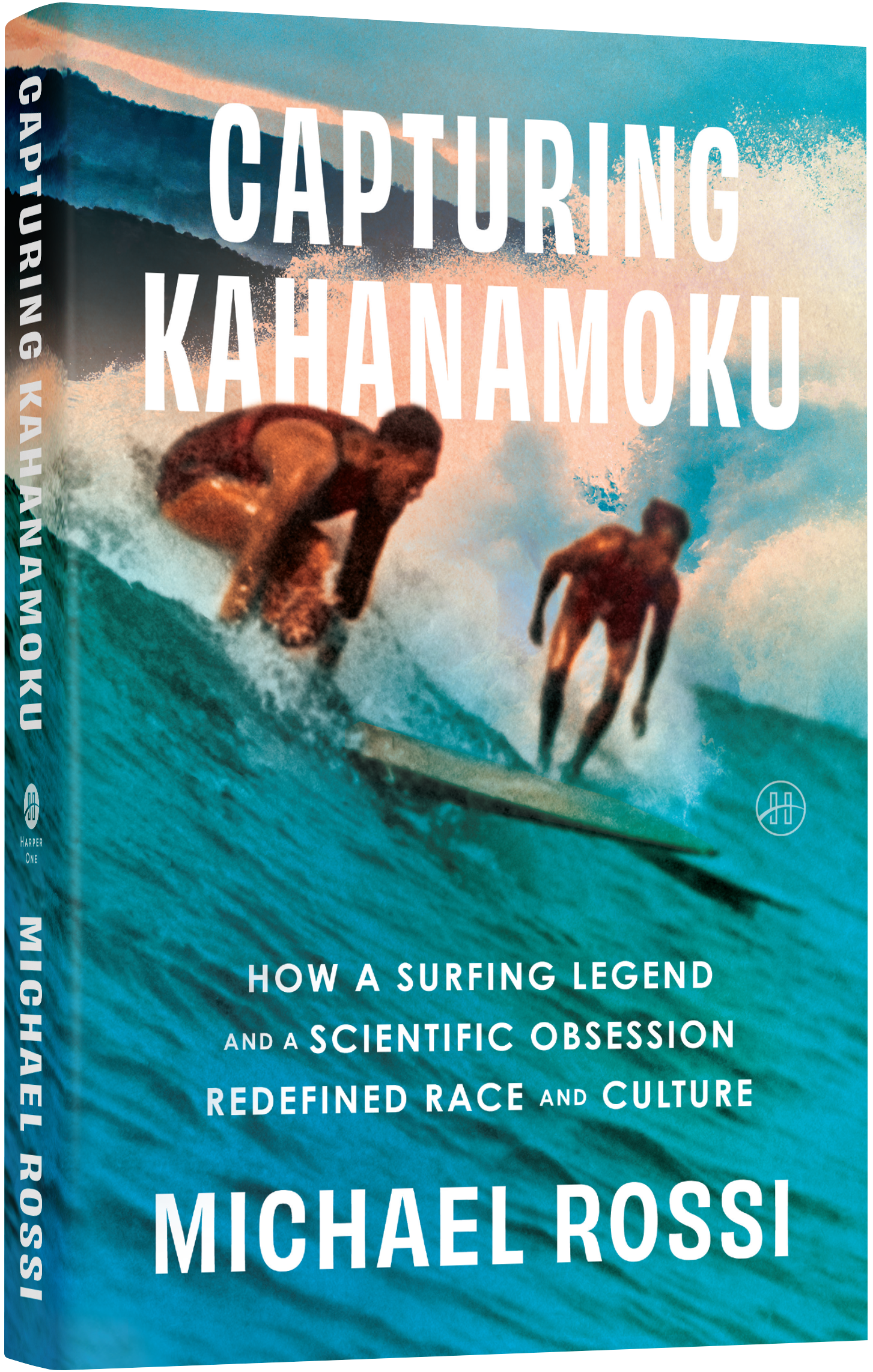
In Capturing Kahanamoku: How a Surfing Legend and a Scientific Obsession Redefined Race and Culture (HarperOne), author Michael Rossi revisits how eugenics proponents like Osborn were enamored by Duke’s magnificent physique even as they propagated research findings that “proved” the superiority of the white race. An Associate Professor of the History of Medicine at the University of Chicago, Rossi uncovers what happened when Osborn and his minions chased after Duke and his corporeal self with nefarious intent. The result is a gripping narrative that stretches from the Natural History Museum to Yale’s Peabody Museum to the Bishop Museum on O‘ahu, with Duke and the entire Kahanamoku ‘ohana featured in unexpected roles.
Rossi earned his AB from Columbia University and received a PhD in the history and anthropology of science, technology, and society from MIT. His previous book was The Republic of Color: Science, Perception, and the Making of Modern America (Univ. of Chicago Press).
The Hawai‘i Review of Books recently spoke to him about Capturing Kahanamoku from his office in Chicago. This interview has been edited for clarity and length.
—David Davis
An Interview with Michael Rossi and David Davis
DAVID DAVIS
How did you come to this story and why did you decide to write this book?
MICHAEL ROSSI
I came to the story when I was at the Museum of Natural History in New York City as a graduate student. I was there doing research about the history of the whale model in the Museum—and what compelled men of science to build this maximalist sculpture—when I came across this little slip of paper that said something to the effect of, “We need to send a copy of the cast of David Kahanamoku to the Peabody Museum at Yale.”
This caught my eye because physical anthropologists—and particularly those who work in museums—don’t usually write down the names of the people that they model. They usually write something like, “Sculpture of a Polynesian man.” I’m not a surfer, so the name “Kahanamoku” didn’t mean much to me at the time. But when I followed up on that, I discovered that he was the brother of this world-famous swimmer and surfer and all-around incredible athlete. I was left to wonder: What were a bunch of anthropologists doing trying to cover his brother in plaster?
Part of the best thing about doing history is that you spend a lot of time just looking through people’s old mail and lists and incidental letters, and all of a sudden something just pops out and you’re like, Oh my Gosh, this is really strange or interesting.
DAVID
Your book focuses on the efforts of Henry Fairfield Osborn—the president of the American Museum of Natural History and a eugenicist—to research the people of Hawai‘i, starting around 1920. What was it about Duke Kahanamoku and Hawaiians in general that so fascinated Osborn and many prominent anthropologists of the era? You write that Duke actually took Osborn out surfing!
MICHAEL
Eugenicists like Osborn were fascinated by Hawai‘i because it seemed to be a smoothly functioning, multi-racial democracy. All of their predictions were that, if you start to mix “races”—that is, if you start to mix notional races of people—then society would somehow degenerate or would lose its vitality.
But in Hawai‘i, where there’s all these people who came from all over the world, it wasn’t functioning as a utopia, but certainly it wasn’t plagued with degeneration or any of the things that many eugenicists predicted would befall a multi-racial, multi-cultural nation. So, part of it was that they wanted to conduct a eugenics study just to see, well, how is that possible?
The eugenicists were fascinated with Duke in particular. They always think in terms of “racial types.” This is one of the chilling things about eugenics: There’s never any individuals. Everyone’s merit was always about what type of person they were.
I think Osborn saw Duke as a “chieftain type.” The idea was that, supposedly, in the distant past, Hawaiians and Polynesian people had been these magnificently beautiful, muscular people, but that now their race was going extinct. Osborn saw Duke as almost like a living fossil, just like the fossils of the rhinoceroses that he had worked on, and he had to have that fossil in his collection. He saw Duke as this type that shouldn’t exist, but did exist, and maybe held some sort of clue as to how white humankind might reach that same physical perfection while maintaining its intellectual superiority.
DAVID
You write that one of the most striking features about Hawai‘i is its diversity. Do you think Osborn and his charge, Louis Sullivan, understood this before they conducted their anthropology study of Hawai‘i?
MICHAEL
They definitely understood that the population was diverse. One of the things that was so interesting to me researching this is that, they didn’t have the same idea of culture as we do today. They had this idea that culture was the thing that “advanced” European civilizations did, and everything else was not really culture.
You get the sense that they’re in this place where all this cultural innovation is going on—like Duke and his crew inventing beach boy culture and a whole new way of doing sports and leisure—but fascinatingly enough, even though this moment in history was right in front of their faces, they just couldn’t see it. They didn’t have the right framing or the right amount of imagination to be able to see it.
“If all you have to worry about is genes, then the problem of childhood achievement doesn’t become one of social will. People can just shrug it off and say, the young Hawaiian child is by nature indolent and that’s why Hawaiians are poorer than the children of missionaries.”
DAVID
Why did the eugenicists place so much emphasis on measuring the skulls and other physical attributes of human beings? What was the purpose of this and what were they trying to prove by using these measurements?
MICHAEL
They were trying to collect evidence that non-white people were less intelligent—or less thrifty or less industrious or less virtuous across a number of different spectrums—than Europeans, depending on the flavor of eugenicists that you’re talking about. Many of them were obsessed with Nordics, but many of them just said, “Well, any European is pretty much better than any non-European.” I should also add that there were eugenicists in other countries. So, Japanese eugenicists definitely do not think that Nordic people were superior. They thought that, of course, Japanese people were the superior race.
They ended up measuring people and trying to obsessively catalog people’s physical features as a way of distilling race down to measurable attributes. Ultimately, what they’re hoping to do is to establish statistical correlations between different morphological features of people and qualities like intelligence. They were convinced that almost any kind of human behavior could be mapped on to genes of some sort.
They didn’t really have our sense of what genes are, but they knew that there was heritable material. They had a long list of things that they thought were heritable. They were convinced that musical ability was heritable and the love of songbirds was heritable. The “tendency to like weird things” was on the list of being heritable. I mean, how can you possibly measure that?
DAVID
You relate in the book that Louis Sullivan—the visiting anthropologist—was tasked with taking a full-body plaster cast of Duke Kahanamoku, but ended up using his younger brother David as his model instead. What happened?
MICHAEL
Duke was clearly not interested in being measured or cast. He was a very polite and laid-back guy, but he was also very willful. You get the sense that he just decided, “Naw, I’m not doing that.” There’s these letters from Osborn saying, “We need to get Duke. Can we invite him to this thing?” Then, after Duke didn’t show up, Osborn would try again, and then Duke wouldn’t be there.
Eventually, the territorial governor of Hawai‘i [James McCarthy], who was in the same network of people as Osborn, took Duke aside and said, “Okay, look, you need to do this for science.”
I had the great pleasure of talking to David Kahanamoku Jr., David’s son. He said that the way that the family dynamic worked was, David was sort of Duke’s backup guy. So, in this case, Duke sent David instead.
The plan was for Duke to do a follow-up plaster cast. But according to [his brother] David, the experience [of casting] was just too miserable, and the feeling was, no one in the family was going to go through this again.
DAVID
David’s cast became the centerpiece of a eugenics exhibit at the Natural History Museum. What was the purpose of the plaster casts for the anthropologists?
MICHAEL
It was a cast of David Kahanamoku, but in a conceptual sense it was really a cast of a generic Hawaiian guy. They were like, “Okay we’ve got this cast of this perfect specimen of humanity.” Then they made multiple copies of David’s cast and sent it all over the place. They were doing the same things that they would do with casts of dinosaur bones or casts of fish or when they were casting the whale. Oftentimes, they would make a cast and then they would farm it out to other museums, either for money or for prestige.
DAVID
When is it that eugenics falls so far out of favor that museums no longer highlight these casts?
MICHAEL
Definitely by the 1930s and 1940s eugenics is more out of favor. It never totally disappears, and unfortunately many involuntary sterilization laws stayed on the books into the early 21st century.
The cast of David Kahanamoku in the Bishop Museum was up until 2005, if I’m not mistaken. The cast at the Peabody came down in the 1990s, and I think the one at the Museum of Natural History came down in the 1960s. The cast at the Bishop Museum became a manikin that you’d hang different articles of clothing on.
DAVID
You write that Hawai‘i’s people “provided a poor example of the perils of race mixing for American civil society.” Was sending Sullivan to Hawai‘i a mistake? Did Hawai‘i prove him and his “science” wrong?
MICHAEL
At the very end of the day, yes absolutely. Sullivan died a pretty staunch eugenicist, but you get little inklings that his faith might be slipping. At one point he says something like, “Well, it doesn’t seem like race mixing is all that bad actually.”
But that didn’t stop people like Harry Laughlin, the director of the Eugenics Record Office, which was the main clearinghouse of eugenics information. He gives testimony in front of Congress during debates over the widespread anti-immigration law [the Johnson-Reed Immigration Act of 1924]. He uses Sullivan’s data exactly in the wrong fashion to say, look, race mixing is leading to the extermination of the Hawaiian people and will lead to the extermination of the white race too if we allow these immigrants in. He’s able to give a perverse reading of Sullivan’s findings that appears to uphold the thesis of eugenicists.
Eugenicists call themselves scientists, but they’re almost like black magic-ists or occultists of some sort because eugenics is so flexible and mushy. Any kind of data can fit the eugenic mind-set.
DAVID
When you went back to study the history of eugenics, what struck you most about its controversial history? Why did so many prominent people believe in it? Was it a sign of the times as science evolved or was it something more than that?
MICHAEL
I definitely think that it was something more than that. I also think that it’s something that we’re wrestling with right now in 2025, with the advent of new genetic technology like polygenic index scores and genome-wide association studies and these big data projects that purport to find correlations between certain kinds of genes and anything from a tendency towards opioid addiction, a tendency to get divorced, or educational attainment or income.
I think the reason why people are fascinated with these kinds of studies is for the same reason that eugenics was so popular and so seductive: it provides a simple, seemingly scientific answer to complicated social questions. If all you have to worry about is genes, then the problem of childhood achievement doesn’t become one of social will. People can just shrug it off and say, the young Hawaiian child is by nature indolent and that’s why Hawaiians are poorer than the children of missionaries.
DAVID
What was the biggest challenge that you faced researching the book?
MICHAEL
The first biggest challenge was writing about Duke because while he was clearly a really smart man, a really driven man, and a man of principle, he did not write a lot down. He was a tight-lipped guy. As a historian of science, I’m used to going through the archives of these graphomaniac scientists who write down every thought that comes through their head. You can get a pretty good sense of what someone’s thinking at a given time, even if they change their mind or they’re vacillating.
With Duke, it was really hard to tease out answers to questions like, Why did he avoid these eugenicists and what was his opinion about this?
DAVID
What most surprised you in your research?
MICHAEL
I was surprised to find out that the Kahanamoku brothers were featured in not one but two exhibits where they were to exemplify all Hawaiian people everywhere, with [Duke’s younger brother] Sargent being the model for the Polynesian Man in “The Races of Mankind” exhibit [in 1933 at the Field Museum of Natural History in Chicago]. It was a pretty huge historical coincidence.
On another level, the picture of Hawai‘i in the 1920s that emerged through my research was unexpected to me. The research that I had done from a mainland perspective made it seem like Hawai‘i was this sleepy colonial outpost. It was the place that you’d send your ships to load up on coal before they kept going across the Pacific. Or, it was just a bunch of sugar and pineapple plantations.
I was really surprised when I began to delve into the reminiscences of people living there and the newspapers that would give a daily slice of life just how active and vibrant and innovative the scene was, and especially the beach scene. Like many a kid who grew up in Pennsylvania, I didn’t know much about that. I thought a beach boy was either from the singing group or maybe Sean Penn’s character in Fast Times at Ridgemont High.
So, that was a big surprise to realize that the beach boys were these real guys. They were always characterized as these indolent individuals who spent their days surfing and swimming and picking up women. But, no, they were real movers, hard workers. They were hustlers and entrepreneurs who figured out a way to make money in this most improbable of ways.
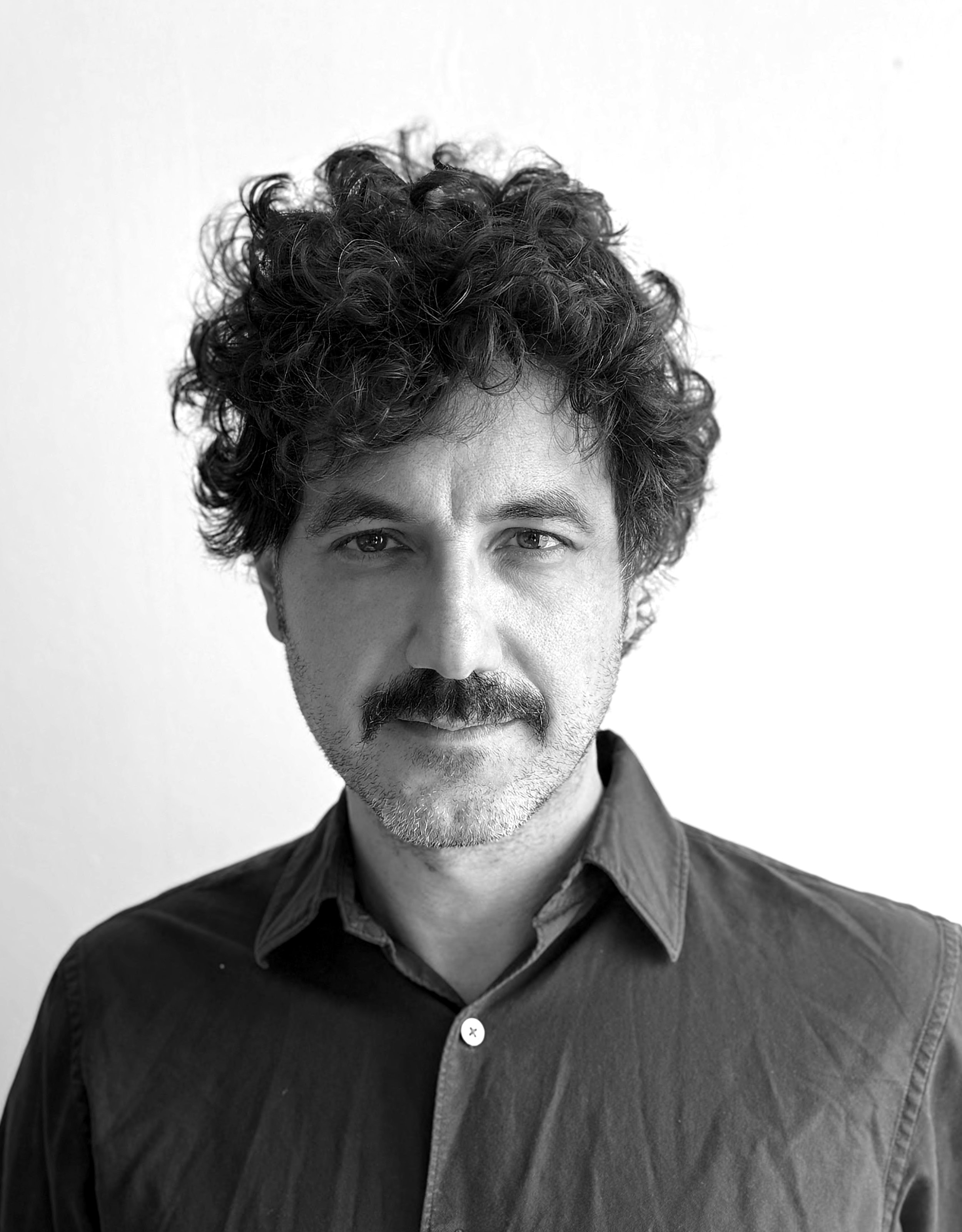
Michael Rossi is a historian of science and medicine at the University of Chicago. He is the author of Capturing Kahanamoku: How a Surfing Legend and a Scientific Obsession Redefined Race and Culture and The Republic of Color: Science, Perception, and the Making of Modern America. His work has appeared in Isis, the London Review of Books, Nature, and Cabinet, among other publications. At the University of Chicago, Rossi is a member of the history department, the Committee on Historical and Conceptual Studies of Science, and the MacLean Center for Medical Ethics.
Banner image courtesy of Sangharsh Lohakare.
David Davis is the author of Waterman: The Life and Times of Duke Kahanamoku (University of Nebraska Press, 2015), selected as one of Hawai‘i’s 50 Essential Books by Honolulu Magazine. His last book was Wheels of Courage: How Paralyzed Veterans from World War II Invented Wheelchair Sports, Fought for Disability Rights, and Inspired a Nation (Center Street, 2020). An acclaimed sports documentarian for three decades, he has won numerous awards and published in Sports Illustrated, Smithsonian, the New York Times, the Los Angeles Times, the Wall Street Journal, Deadspin, and Vice.